Quick answer
A cubicle cannot be made soundproof with a screen or panel alone. Reduce distraction by identifying the source, travel path, receiver, task, and time pattern, then combine appropriate zoning, distance, room absorption, screened sightlines, sound masking, equipment control, behavior protocols, and access to enclosed rooms. Verify results in the occupied space.
On this page8 sections
Key takeaways
- Treat soundproof cubicle as a search phrase, not a realistic performance promise for an open workstation.
- Describe the event: source, listener, task, route, direction, duration, frequency, timing, and consequence. General complaints such as too noisy are not enough to select a control.
- Work from source to path to receiver, and prefer controls that address more than one event without creating a new operational problem.
- Coordinate panel or screen choices with the ceiling, floor, walls, room geometry, workstation gaps, background sound, layout, and behavior.
- Separate ordinary distraction and speech-privacy planning from potential hazardous-noise evaluation, confidential-room design, and individual accommodation processes.
- Use an occupied-space baseline, a documented trial, and a post-change check instead of relying only on a product label.
Action ladder: make a controlled first trial, then escalate when the outcome needs design or measurement. Open table
| Observed event | Try this week | Escalate when |
|---|---|---|
| Nearby calls or conversations interrupt focus | Move the call activity, rotate the source and receiver, test a quiet period, and provide a usable enclosed-call option | Speech remains broadly intelligible, the change affects many stations, or a defined privacy result is required |
| Speakerphone or video meetings spill into adjacent stations | Trial headsets, lower device level, move group calls, and check microphone and speaker placement | Technology, room reflections, or multiple meeting zones require coordinated audiovisual and acoustic design |
| Printer, fan, alert, or other equipment creates a repeating event | Record the timing, inspect maintenance status, adjust authorized settings, and trial relocation away from focus work | The source may indicate a maintenance, occupational-noise, alarm, or building-system issue |
| Speech carries across a large reflective area | Test activity zoning, added distance, changed orientation, and one representative absorptive-treatment mock-up | Ceiling, wall, masking, HVAC, or room-level performance must be specified and commissioned |
| A conversation or task requires confidentiality | Move the activity to an appropriate enclosed setting and define who needs privacy from whom | A contractual, legal, clinical, personnel, security, or measured speech-privacy outcome applies |
Diagnose one real noise event from source to receiver
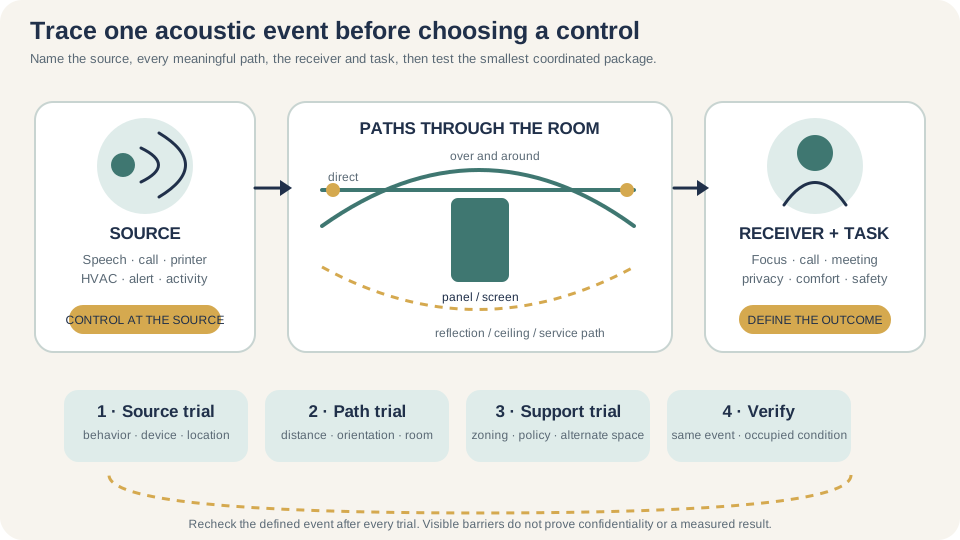
Define the acoustic problem before selecting a product
Noise is not one condition. A nearby conversation that breaks concentration, intelligible speech that creates a privacy concern, a printer that cycles intermittently, continuous mechanical sound, an alert, a video meeting, and a short high-level event can require different responses. Record what is heard, where, during which task, for how long, how often, and what outcome matters. Do not diagnose from a photograph or workstation height alone.
| Field | Record | Why it changes the response |
|---|---|---|
| Source | Speech, speakerphone, equipment, impact, HVAC, alert, or activity plus exact location | Source control may be more effective than treating every receiver |
| Receiver and task | Who is affected and whether the task is focus, call, collaboration, training, or confidential work | Different tasks tolerate and require different acoustic conditions |
| Path | Direct sightline, over-panel route, gap, hard reflection, ceiling path, duct, or adjacent opening | A control works only when it changes a meaningful path |
| Pattern | Time, duration, repetition, occupancy, direction, and workstation or room condition | Scheduling, zoning, maintenance, or behavior may solve a time-specific event |
| Outcome | Less intelligibility, fewer interruptions, lower annoyance, better call quality, or a formal privacy criterion | The acceptance test must measure the desired result |
GSA's Sound Matters frames office acoustic comfort as a combination of work patterns, speech-privacy needs, behavior, zoning, planning, absorption, masking, and appropriate room construction. GSA's indoor-environmental-quality resource likewise discusses relationships among zoning, equipment, HVAC, building paths, scheduling, and verification. These sources support a coordinated process rather than a single-product shortcut. [1] [2]
Use the source–path–receiver model
A practical investigation follows sound from the activity that creates it, through every important transmission or reflection path, to the person or space affected. Start near the source because a lower voice level, headset, equipment repair, quieter alert, relocated printer, enclosed call room, or changed schedule may reduce exposure along several paths. Then examine separation, orientation, barriers, absorptive surfaces, masking, and the receiver's task or location.
| Layer | Questions | Possible trials |
|---|---|---|
| Source | Can the activity, voice behavior, device, alert, equipment, or location change? | Headset trial, maintenance, call-room use, alert setting, scheduling, or relocation |
| Direct path | Do speakers and receivers face one another, and can orientation or distance change? | Rotate the setting, move collaboration points, or establish a buffer |
| Boundary path | Does sound pass above, around, beneath, or through workstation elements? | Mock up a documented screen or panel condition without claiming enclosure |
| Room path | Are hard ceilings, floors, walls, glazing, or long open runs reinforcing propagation? | Qualified review of ceiling, wall, or other absorptive treatment |
| Background | Is the room extremely quiet, uneven, or dominated by equipment or HVAC? | Measure and commission a designed masking or mechanical correction approach |
| Receiver and work policy | Can people choose focus space, quiet time, remote participation, or another suitable setting? | Reservation rules, focus periods, enclosed-room access, and team protocols |
Coordinate panels, gaps, ceiling, and room surfaces
Panel height, construction, junctions, openings, and relationship to the source can matter, but the workstation is only one part of the room. Sound can travel over the top, through openings at ends and entries, around a short return, or along a reflective ceiling and wall. Screens on height-adjustable desks also change position and may leave large side paths. Evaluate the complete geometry and selected product, not the nominal cubicle size.
| Element | Verify | Common overclaim |
|---|---|---|
| Panel or screen | Exact construction, test method, height, width, gaps, joints, orientation, and supported installation | Fabric appearance means high absorption or speech privacy |
| Ceiling | Current ceiling system, open-plenum condition, absorptive performance, services, and consultant recommendation | A panel result can be predicted without the ceiling path |
| Walls and glazing | Long reflective surfaces, corners, openings, doors, and treatment locations | Adding material anywhere produces the same result |
| Floor and furniture | Hard or soft areas, storage, upholstery, movable items, and occupied condition | An empty-room impression represents normal operation |
| Mechanical and technology systems | Diffusers, fans, ducts, speakers, devices, microphones, and maintenance condition | All background sound is useful masking |
Combine layout, absorption, masking, and operations
A useful plan usually combines several moderate controls. Separate incompatible activities, keep collaboration and circulation from focus positions, provide enclosed settings for calls or work that requires them, orient speech away from receivers, add qualified absorptive treatment where it addresses room paths, and establish behavior protocols with the users affected. Sound masking is a designed system that should be specified, zoned, adjusted, and commissioned for the occupied workplace; it is not a collection of desktop white-noise devices placed without coordination.
| Control | Useful when | Boundary |
|---|---|---|
| Activity zoning | Calls, collaboration, circulation, and focus work can be separated by location or time | Must preserve adjacencies, routes, supervision, inclusion, and room availability |
| Distance and orientation | A direct source–receiver relationship dominates the complaint | Room reflections and other directions still require testing |
| Absorptive treatment | A qualified review identifies reflective room paths and suitable locations | Use product test data and room-level design; appearance is not evidence |
| Sound masking | The design objective includes reducing distraction or speech intelligibility across an open area | Requires professional design, zoning, commissioning, user communication, and ongoing control |
| Behavior protocol | Recurring calls, speakerphone use, conversations, alerts, or interruptions have an operational cause | Develop with users and provide workable alternative settings |
| Enclosed room | A task needs a degree of privacy or isolation that an open cubicle cannot credibly provide | Room construction, doors, ventilation, technology, accessibility, and booking still need design |
GSA explicitly treats behavior, work patterns, zoning, planning, absorptive ceilings and walls, masking, and room construction as related tools. Its guidance is not a specification for every workplace, but it is a strong reason to involve acoustical and building professionals early when the outcome matters. Record which party owns room analysis, masking, HVAC, technology, furniture, policy, user communication, measurement, and acceptance. [1] [2]
Run a controlled trial and verify the occupied result
-
Create the baseline
Record the event, locations, room and workstation condition, occupancy, task, time pattern, complaints, and any qualified measurements before changing the space.
-
Choose one testable package
State which source, path, receiver, or operational condition each proposed action addresses and which conditions remain outside scope.
-
Review side effects
Check routes, daylight, glare, ventilation, sprinklers and alarms, technology, furniture operation, supervision, accessibility, cleaning, and future change with responsible parties.
-
Trial representative conditions
Test in an occupied or realistically simulated setting. Keep the source activity, receiver task, configuration, and observation method consistent enough to compare.
-
Measure the intended outcome
Use a qualified acoustical professional when speech privacy, confidential activity, performance criteria, system commissioning, or technical measurement is required.
-
Document and maintain
Record accepted settings, locations, products, control access, policy, training, maintenance, complaints, retest triggers, and the party authorized to change the solution.
Do not release the solution until these questions have owners
- Which acoustic event and outcome are in scope, and which are explicitly excluded?
- Who owns furniture, ceiling, wall, HVAC, masking, technology, behavior, policy, measurement, and acceptance?
- Which current product data, room information, consultant criteria, and building approvals support the design?
- How will confidential work, individual accommodations, remote meetings, and short high-noise events be handled?
- What will be observed or measured before and after the change, under which occupied conditions?
- What maintenance, calibration, training, complaint, and retest process continues after closeout?
Frequently asked questions
Can you soundproof a cubicle?
Not in the same sense as a properly designed enclosure. An open workstation has paths over and around boundaries and through the room. You can reduce specific distractions or speech intelligibility with a coordinated package, but the outcome must be defined and verified without a soundproof guarantee.
Do taller cubicle walls reduce noise?
They may change a direct path in some configurations, but results depend on source and receiver position, panel construction, gaps, ceiling, walls, room geometry, background sound, and other paths. Height also affects light, views, supervision, coordination, and product compatibility.
Do acoustic desk dividers work?
They can contribute when the exact product's tested properties, dimensions, placement, and surrounding room address the diagnosed path. A desk divider alone does not establish speech privacy or soundproofing, and a soft-looking material is not proof of acoustical performance.
Is white noise the same as sound masking?
Use sound masking to describe a designed and commissioned building or workplace system with an intended acoustic objective. Consumer white-noise devices, music, fans, and uncontrolled mechanical noise are not interchangeable substitutes and may create uneven or distracting conditions.
What is the first step for a noisy open office?
Document specific events rather than asking for a general noise fix. Identify source, receiver, task, path, timing, occupancy, consequence, and desired outcome. Then test source controls, zoning, layout, room treatment, masking, operations, and alternative settings as a coordinated set. [1] [2]
When should an acoustical consultant be involved?
Use qualified help when the project needs technical criteria, measurement, speech-privacy or confidentiality outcomes, room or ceiling design, sound masking, HVAC coordination, contractual acceptance, or diagnosis after simple operational trials fail. Occupational-noise and accommodation concerns also need the appropriate specialized process.
Sources and limitations
This guide is a diagnostic and coordination framework. It does not predict decibel reduction, speech privacy, confidentiality, code compliance, health risk, or product performance in a specific room.
The GSA sources provide federal workplace-oriented guidance and examples, not a substitute for a project acoustic brief, current product data, qualified measurement, adopted requirements, or responsible design. Claims and acceptance criteria should be written for the actual occupied space and maintained configuration.
- U.S. General Services Administration: Sound Matters: How to Achieve Acoustic Comfort in the Contemporary Office
- U.S. General Services Administration: Indoor Environmental Quality